
Webhooks
Webhooks turn s3BEAR's state-changing events into outbound HTTP callbacks, so external systems can react in near real time — trigger a search re-index on upload, generate a thumbnail, post to Slack, or invalidate a cache.
s3bear.example.com
Delivery lifecycle
How it works
- An admin registers endpoints, each subscribing to a set of events (the same names
as audit actions, or
*for all). - When a subscribed event occurs, a delivery is enqueued in the same database transaction as the audit record — so an action that rolls back never fires a webhook.
- A background dispatcher POSTs each delivery as JSON, signed with HMAC-SHA256, and
retries with backoff up to
WEBHOOK_MAX_ATTEMPTS(default 4: the initial attempt plus three retries at ~1m / 5m / 30m). - Every attempt is recorded (
status,attempts,last_status_code,last_error), visible per endpoint in the UI.
Payload and headers
POST /your/endpoint HTTP/1.1
Content-Type: application/json
X-S3Bear-Event: upload
X-S3Bear-Delivery: 4b2f...      (delivery id)
X-S3Bear-Signature: sha256=...  (HMAC of the raw body, keyed with your secret)

{
  "event": "upload",
  "timestamp": "2026-08-19T10:00:00+00:00",
  "actor": { "user_id": "…", "email": "[email protected]" },
  "bucket": "builds-staging",
  "object_key": "nightly/app.bin",
  "details": { "size": 10485760, "content_type": "application/octet-stream" }
}
Verifying the signature
Compute HMAC-SHA256 over the raw request body with the endpoint's signing secret
(shown once at creation) and compare, in constant time, to the X-S3Bear-Signature
header:
import hmac, hashlib

def verify(secret: str, raw_body: bytes, header: str) -> bool:
    expected = "sha256=" + hmac.new(secret.encode(), raw_body, hashlib.sha256).hexdigest()
    return hmac.compare_digest(expected, header)
How to use
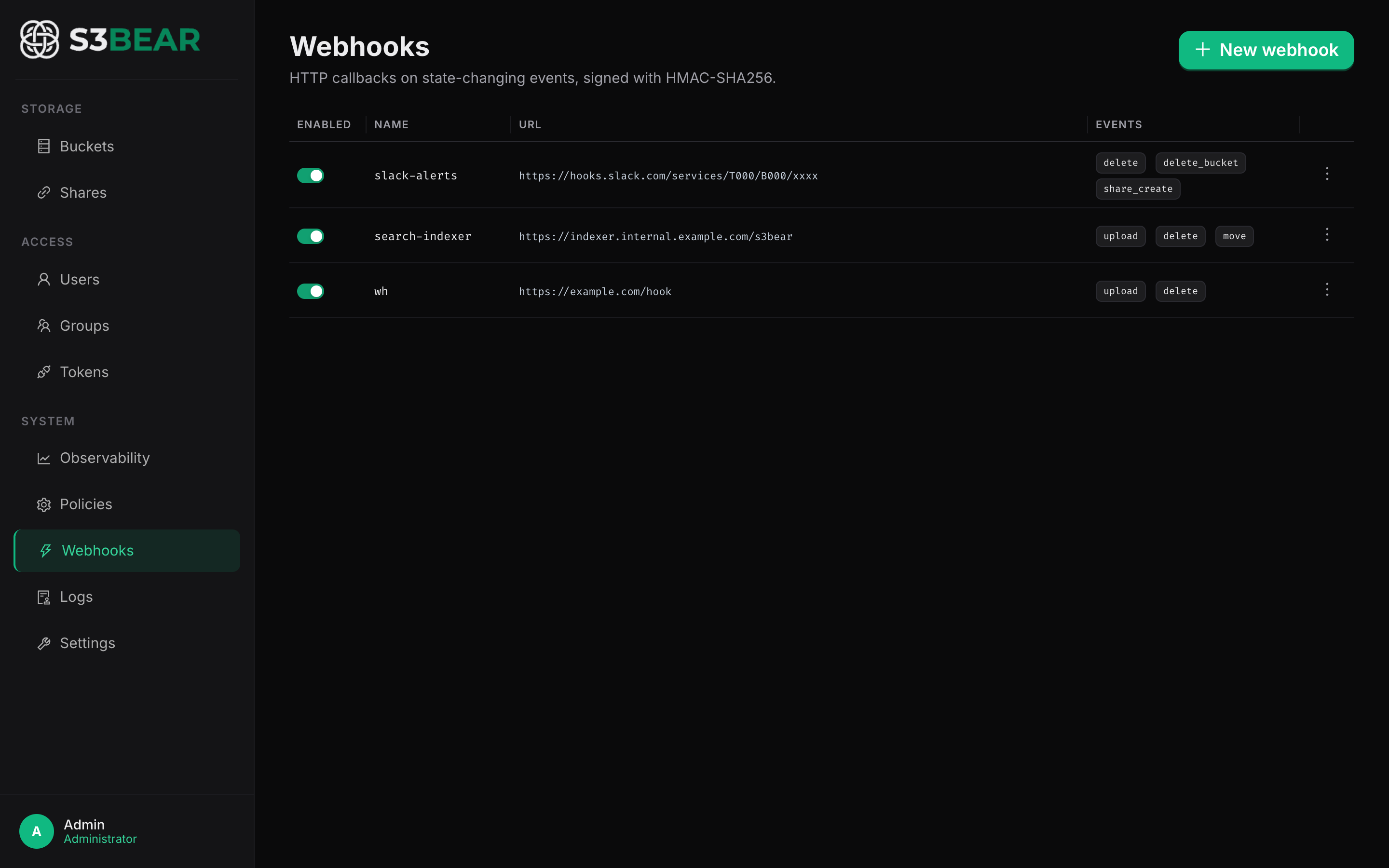
In the UI: Webhooks (admin) → New webhook → set a name, URL, and events → copy
the signing secret (shown once). Use test to enqueue a synthetic ping delivery, and
deliveries to inspect recent attempts. Toggle enabled to pause an endpoint.
# Create an endpoint subscribed to object writes/removals
curl -X POST http://localhost:8200/api/v1/webhooks \
  -H "Authorization: Bearer $TOKEN" -H "Content-Type: application/json" \
  -d '{
    "name": "indexer",
    "url": "https://indexer.internal/s3bear",
    "events": ["upload", "delete", "move"]
  }'
# → { "id": "...", "secret": "…shown once…", "events": [...], "enabled": true }

# Inspect recent deliveries
curl http://localhost:8200/api/v1/webhooks/<id>/deliveries \
  -H "Authorization: Bearer $TOKEN"
Return any
2xxto acknowledge a delivery; any other status (or a timeout) triggers a retry.
Use case: auto-thumbnail pipeline
Subscribe an endpoint to upload. When a new image lands, your service receives the
bucket and key, fetches a resized copy from the
image proxy (?w=256&format=webp), and writes the thumbnail
back — no polling, no cron.
Use case: compliance alerting
Subscribe to delete and delete_bucket on sensitive buckets. Post each delivery to a
Slack channel or SIEM so destructive actions are surfaced immediately, alongside the
tamper-evident audit log.
Configuration
| Env variable | Default | Purpose |
|---|---|---|
WEBHOOKS_ENABLED | true | Enable webhook enqueue + dispatch |
WEBHOOK_MAX_ATTEMPTS | 4 | Delivery attempts before a webhook is marked failed |
WEBHOOK_TIMEOUT_SECONDS | 10 | Per-delivery HTTP timeout |
Related: Audit Log · Configuration